
THE OTHER SIDE OF THE STORY
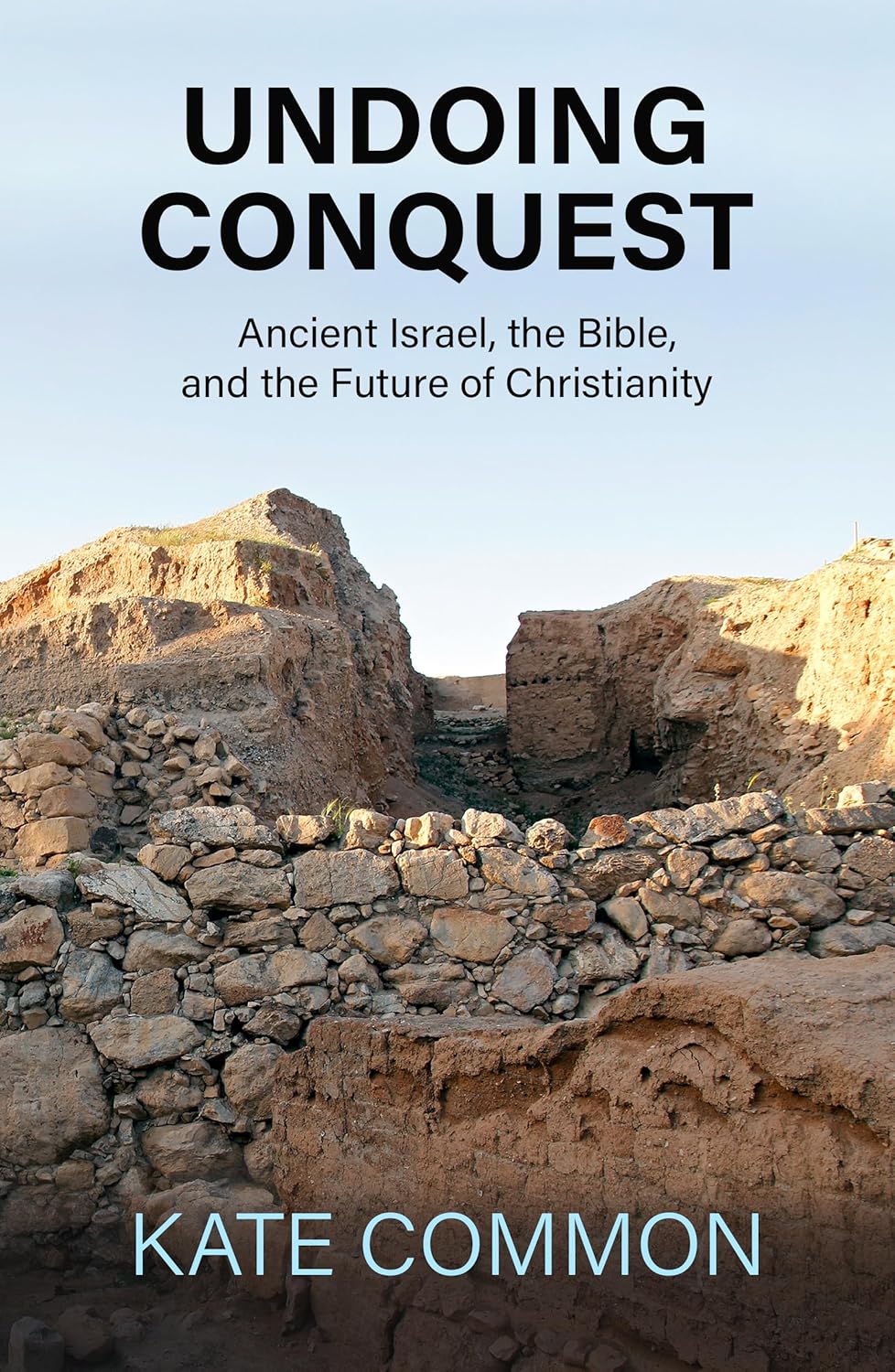
Common, Kate. Undoing Conquest : Ancient Israel, the Bible, and the Future of Christianity. Maryknoll: Orbis Books, 2024.
Biblically, the world has been torn by war since the nearly the beginning of time. Cain slew Abel whose offering to God was looked upon with favor.[1] There is an old adage that says history is written by the victor.[2] The Bible has been used for centuries to propagate conquest as the means to the fulfillment of God’s kingdom on earth.[3] The instructions in Deuteronomy 20:16-18 are quite clear.
“But as for the towns of these peoples that the Lord your God is giving you as an inheritance, you must not let anything that breathes remain alive. Indeed, you shall annihilate them—the Hittites and the Amorites, the Canaanites and the Perizzites, the Hivites and the Jebusites—just as the Lord your God has commanded,so that they may not teach you to do all the abhorrent things that they do for their gods and you thus sin against the Lord your God”(NRSVUE).
What if we are reading the Bible wrong? What if the some of the most prominently quoted books and the main characters of the Bible are meant as examples of what not to do rather than examples of how humanity is supposed to behave?[4] If that is true, how does the Christian God want people to behave? Perhaps we are to behave more like the secondary characters than the primary ones.
Rahab, a prostitute and member of an “unclean” race of people, is cited in the genealogy of Jesus, confirming that she is highly regarded for her heroic behavior on behalf of Israel.[5] Rahab, neither Israelite nor chaste, changes the course of Israelite history standing proud and brave where Israelite scouts hid in fear. Rahab represents disobedience to Deuteronomistic commands through the scouts mingling with a Canaanite.[6] She hid the Israelite’s scouts and gave them information which led to victory over Jericho. The Israelite scouts, then take credit for Rahab’s information.[7]
In the story of Jacob and Esau, Jacob betrays his brother Esau tricking him out of his inheritance.[8] Esau however, marries a Hittite woman, a foreigner and warmly welcomes Jacob back with open arms despite all that his brother had done to him. It seems the Gentiles demonstrate God and their neighbor is some miraculous non-violent ways. Jesus would send not just his disciples to share the Good New but also the unsendables: Samaritan’s, Gentiles, women, etc. to spread the Good News.[9]
In the United States, women had little voice or presence, not being treated as citizens until 1920.[10] Women existed in history across most cultures of the world as mere objects or possessions.[11] Occasionally, they did impact the course of events enough that their presence had to be identified but not so much as their name deserved to be recognized.[12] As the Syrophoenician woman experienced, they were mentioned in the capacity one might tell a story about their dog.[13] Women’s liberation did not come through violence but “victory took decades of agitation and protest.”[14] The Syrophoenician woman was not just female but also a member of a minority who failed to recognize her place in society and was rewarded for it. Her agitation and protest healed her daughter.
Despite numerous examples of how those who are obedient to God and seek peaceful rather than violent resolutions, the Bible continues to be used to foster conquest and colonialism today. Authors such as Yak-hwee Tan share how colonialism affected their childhood education and their working life today. Tan shares how they grew up in Singapore forced by the school system to suppress their own culture. Tan states “I learned more about the Bible, British history, and English literature than about Chinese history and literature.”[15]
Christianity requires new converts to replace the history of their people with the history as described in the Hebrew and New Testaments.[16] For many cultures, such as Native Americans, the closest Biblical analogy to their own personal history is to that of the enemy, the Canaanites, rather than to the Israelite oppressors who usurped their land and were instructed to commit genocide.[17] Joshua and Leviticus lead readers to believe that the Canaanites, deserved to be purged from the earth.[18] Native American’s would choose to interpret God’s kingdom as including not just all of humanity but all of nature as well.[19] This changes the appearance of the coming together of all nations in Revelation dramatically. The multicultural church would look more like Noah’s Ark than a UN Convention.
Conquest is not the only means of achieving God’s kingdom here on earth. There is ample biblical evidence to demonstrate that peaceful means are much more productive. Archaeological finds such as the Highlands Settlement are providing scientific evidence that the conquest narrative of the Bible may not be as infallible as once thought.[20] Stories told by those who have suffered and overcome significant trauma often contain liberative elements and use language of combat and fighting against forces of oppression.[21] Seeking control in an out-of-control environment thrives on empowerment but power cannot come at eh expense of others. Stories of conquering and triumphing in the face of adversity can inadvertently serve to perpetuate the very thing they are trying to overcome. The idea of conquest must be undone.
BIBLIOGRAPHY
“19th Amendment to the U.S. Constitution: Women’s Right to Vote (1920),” National Archives. https://www.archives.gov/milestone-documents/19th-amendment. Accessed November 8, 2024.
Collins, Adela Yarbro Collins, “Mark: A Commentary,” Hermeneia- A Critical and Historical Commentary on the Bible. Edited by Harold W. Attridge. Minneapolis:Fortress Press, 2007.
Common, Kate. Undoing Conquest : Ancient Israel, the Bible, and the Future of Christianity. Maryknoll: Orbis Books, 2024. Kindle edition.
Gonzalez, Justo L. For the Healing of the Nations: The Book of Revelation in an Age of Cultural Conflict. Maryknoll: Orbis Books, 2002.
Knust, Jennifer Wright. Unprotected Texts: The Bible’s Surprising Contradictions About Sex and Desire. New York: Harper One, 2011.
Matthew Phelan, “The History of “History Is Written by the Victors,” Slate. November 26, 2019, https://slate.com/culture/2019/11/history-is-written-by-the-victors-quote-origin.html. Often attributed to Winston Churchill or Hermann Göring but cannot be officially traced to either of these two, although arguably they could have said it. The phrase has recorded use as early as the mid 1800’s in both Europe and America.
Tan, Yak-hwee. “Postcolonial Feminist Biblical Criticism: An Exploration.” In Feminist Biblical Studies in the Twentieth Century: Scholarship and Movement, 281–92. Atlanta, 2014. https://search.ebscohost.com/login.aspx?direct=true&db=lsdar&AN=ATLA0001998671&site=ehost-live.
Tinker, George E. “Indian Culture and Interpreting the Christian Bible.” Chapter in Spirit and Resistance: Political Theology and American Indian Liberation. Minneapolis: Fortress Press. 2004.
Wilharm, Sharon. “78 Nameless Women in the Bible With Stories to Tell.” All God’s Women. Accessed on November 8, 2024. https://sharonwilharm.com/nameless-women-in-the-bible/.
[1] Gen 4:4-5
[2] Matthew Phelan, “The History of “History Is Written by the Victors,” Slate. November 26, 2019, https://slate.com/culture/2019/11/history-is-written-by-the-victors-quote-origin.html. Often attributed to Winston Churchill or Hermann Göring but cannot be officially traced to either of these two, although arguably they could have said it. The phrase has recorded use as early as the mid 1800’s in both Europe and America.
[3] Kate Common, Undoing Conquest : Ancient Israel, the Bible, and the Future of Christianity, (Maryknoll: Orbis Books, 2024), Kindle edition,
[4] 2 Sam 12:15-17 The death of David and Bathsheba’s first son due to David’s actions of adultery, conspiracy and murder. Numbers 32:13 Israel is forced to wander the desert for 40 years due to their disobedience. 2 Kings 17: 7-23 The Israelites are exiled from the promised land. These are just a few examples of disobedience and punishment from the Hebrew Bible.
[5] Matt 1:5; Knust, Unprotected Texts, 132-136.
[6] Common, Undoing Conquest, 97.
[7] Joshua 2:1-24
[8] Genesis 27:1-33:9
[9] John 4:28 The Samaritan woman at the well goes to tell the town of Jesus has done. Mark 5:19 Jesus sends the man possessed by Legion to go tell what the Lord has done for him. Matthew 28:10-11 Jesus tells the women to go to the disciples and tell them what they have seen.
[10] “19th Amendment to the U.S. Constitution: Women’s Right to Vote (1920),” National Archives. https://www.archives.gov/milestone-documents/19th-amendment.
[11] Knust, Unprotected Texts, 177.
[12] Sharon Wilharm, “78 Nameless Women in the Bible with Stories to Tell,” All God’s Women. Accessed on November 8, 2024, https://sharonwilharm.com/nameless-women-in-the-bible/.
[13] Mark 7:24-30. Adela Yarbro Collins, “Mark: A Commentary,” Hermeneia- A Critical and Historical Commentary on the Bible, ed. Harold W. Attridge(Minneapolis: Fortress Press, 2007),367. “In rabbinic literature, “dog” Is used metaphorically for a person who is unlearned in the scripture, Mishnah, and Talmud; for ungodly people; and for Gentiles.”
[14] 19th Amendment to the U.S. Constitution: Women’s Right to Vote
[15] Tan, Yak-hwee. “Postcolonial Feminist Biblical Criticism: An Exploration.” In Feminist Biblical Studies in the Twentieth Century: Scholarship and Movement, 281–92. (Atlanta, 2014), 281. https://search.ebscohost.com/login.aspx?direct=true&db=lsdar&AN=ATLA0001998671&site=ehost-live.
[16] George E. Tinker, “Indian Culture and Interpreting the Christian Bible,” Chapter in Spirit and Resistance : Political Theology and American Indian Liberation, (Minneapolis : Fortress Press, 2004), 89; John14:6 states “Jesus said to him, “I am the way and the truth and the life. No one comes to the Father except through me.” (NRSVUE)
[17] Tinker, “Indian Culture,“ 90.
[18] Knust, Unprotected Texts, 134.
[19] Tinker, “Indian Culture,“ 92.
[20] Common, Undoing Conquest, 130.
[21] Common, Undoing Conquest, 98.


Leave a Reply